

Onion juice is a natural topical treatment that can promote hair regrowth for a specific type of hair loss, but it does not stop genetic male pattern baldness. This onion juice hair loss guide for men exists to draw that line clearly.
The 2002 clinical trial published in the Journal of Dermatology showed a 93.7% success rate in men with alopecia areata after six weeks of twice-daily application. That result is real, but it applies to a specific autoimmune condition, not to the receding hairline most men are dealing with. Understanding that difference is the first step toward using this remedy wisely.
How does onion juice work for hair loss in men?
Onion juice works primarily through its high sulfur content. Sulfur is a building block of keratin, the protein that makes up your hair shaft. When applied to the scalp, sulfur compounds in onion juice support follicle strength, improve circulation, and may calm the localized immune response that causes alopecia areata.
Alopecia areata is an autoimmune condition where your immune system attacks hair follicles, causing patchy, coin-sized bald spots. It is not the same as androgenetic alopecia, which is male pattern baldness driven by genetics and the hormone DHT. This distinction matters enormously. Onion juice does not affect DHT, so it cannot slow or reverse the hormonal process behind a receding hairline or thinning crown.
The landmark 2002 randomized clinical trial put numbers to this. Here is what it found:
- 87% of all alopecia areata patients showed measurable hair regrowth after six weeks of twice-daily onion juice application.
- Men specifically hit a 93.7% success rate, outperforming women in the same trial.
- The control group using plain tap water showed only 13% regrowth by week eight.
- The 2002 study focused on alopecia areata, not androgenetic alopecia, which limits how broadly you can apply these results.
One theory worth knowing: onion juice’s effectiveness may partly come from mild scalp irritation that increases blood flow and distracts the immune system rather than from a direct follicle repair mechanism. That is not a knock against it. It just means the mechanism is indirect, and results will vary based on your hair loss type.
How to prepare and apply onion juice safely
Getting the preparation right matters as much as the application itself. Sloppy extraction or skipping dilution steps leads to scalp irritation and wasted effort.
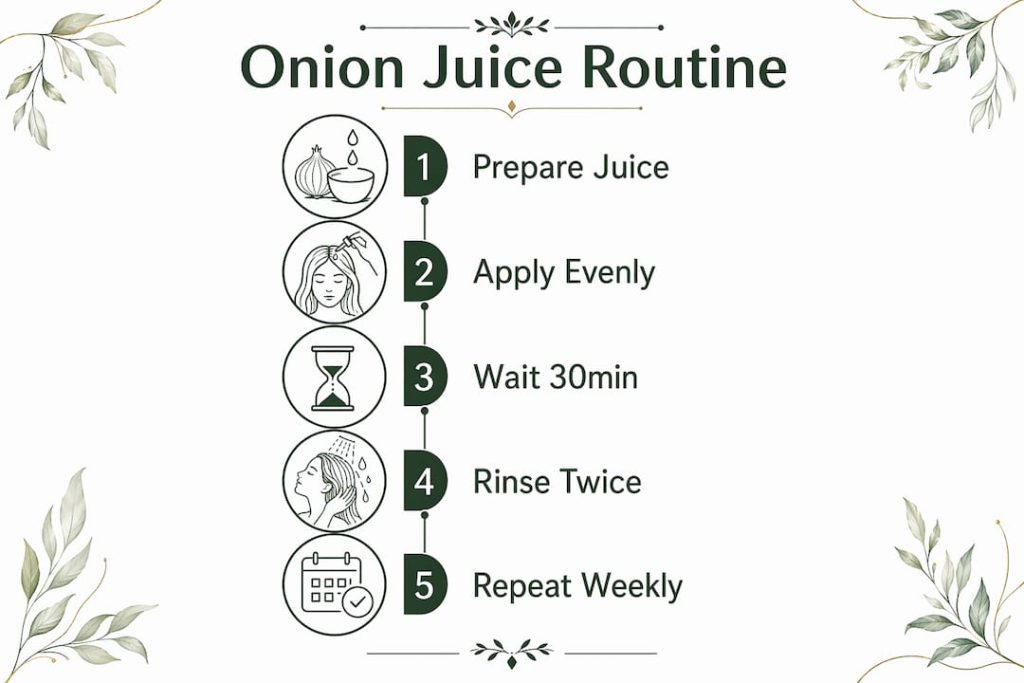
Step-by-step extraction and application:
- Peel and roughly chop two to three medium yellow onions.
- Blend or grate the onion pieces, then strain the pulp through a fine mesh strainer or cheesecloth to collect the juice.
- If your scalp is sensitive, dilute the juice with an equal part of aloe vera gel. This cuts the sulfur intensity without stripping its benefits.
- Add 3–5 drops of rosemary or peppermint essential oil to reduce odor and add a mild circulation-boosting effect. Adding essential oils or aloe vera does not diminish the sulfur potency that makes onion juice effective.
- Before your first application, perform a patch test. Apply a small amount to your inner elbow and wait 15 minutes. Patch testing is essential to avoid contact dermatitis, especially if you have eczema or psoriasis on your scalp.
- Apply the juice directly to your scalp using a cotton ball or your fingertips. Work section by section to cover the affected areas.
- Leave it on for 20–30 minutes, then wash out with a mild sulfate-free shampoo. A second shampoo pass usually handles the residual smell.
Pro Tip: Apply onion juice before a shower rather than after. The warm water and steam from your shower will help open follicles and make the rinse-out far more thorough.
Recommended application frequency is 2–3 times per week, not daily. Daily use increases irritation risk without proportionally improving results. Visible changes may begin around weeks 3–4, but consistent use for 6–8 weeks is the real test.

What side effects should you watch for?
Most men tolerate onion juice well when they follow the preparation steps above. But side effects are real, and knowing the warning signs protects your scalp.
The most common issue is contact dermatitis, a red, itchy, or burning reaction caused by sulfur sensitivity. Men with existing scalp conditions like eczema or psoriasis face the highest risk. Sulfur can cause contact dermatitis or blistering if applied undiluted to compromised skin.
Watch for these specific signals that mean you should stop:
- Persistent redness that does not fade within an hour of rinsing.
- Burning or stinging that intensifies rather than fades during the 20-minute application window.
- Increased shedding beyond your normal baseline after several weeks of use.
- Blistering or crusting on the scalp, which signals a more serious reaction.
“If severe redness, burning, or increased shedding occur after eight weeks of use, discontinue onion juice and consult a dermatologist.” — Dencespot Hair Care Guidelines
Odor is the other challenge men consistently report. The sulfur smell lingers if you rush the rinse. A two-pass shampoo with a mild clarifying formula, followed by a light conditioner, removes it effectively. Some men add a tablespoon of lemon juice to the final rinse water. That works too.
Do not confuse a mild tingling sensation with a harmful reaction. Mild tingling is normal and often signals increased blood flow. Sharp burning, however, is a different signal entirely and means you should rinse immediately.
How does onion juice compare to other hair loss treatments?
Putting onion juice in context against medical and other natural options gives you a clearer picture of where it fits in your routine.
| Treatment | Mechanism | Evidence Level | Best For |
|---|---|---|---|
| Onion Juice | Sulfur, circulation boost, immune modulation | One strong RCT (alopecia areata) | Patchy autoimmune hair loss |
| Minoxidil | Widens blood vessels, prolongs growth phase | Multiple large RCTs | Androgenetic alopecia |
| Finasteride | Blocks DHT conversion | Strong clinical evidence | Male pattern baldness |
| Microneedling | Stimulates follicle repair via micro-injury | Growing clinical support | Pattern thinning, adjunct use |
| PRP (Platelet-Rich Plasma) | Growth factors from your own blood | Moderate clinical evidence | Various hair loss types |
| Saw Palmetto / Pumpkin Seed Oil | Mild DHT inhibition | Preliminary evidence | Early-stage pattern thinning |
Experts advise onion juice as a low-risk natural option for patchy autoimmune hair loss, not as a replacement for minoxidil or finasteride in pattern baldness cases. Medical treatments address the hormonal root cause directly. Onion juice does not.
That said, onion juice is not useless for men with pattern thinning. It can support overall scalp health, improve circulation, and complement other treatments. Think of it as a supporting player, not the lead. If your hair loss is patchy and relatively recent, onion juice deserves a genuine trial. If you have a receding hairline driven by genetics, pair it with a proven medical treatment and manage your expectations accordingly.
Users often overestimate onion juice as a universal cure, which leads to wasted months. Identifying your hair loss type before starting any natural remedy saves time and frustration.
How to build a consistent onion juice routine
Consistency separates men who see results from those who give up after two weeks. A structured routine removes the guesswork.
Pro Tip: Set a recurring phone reminder for your application days. Treating it like a scheduled task rather than an optional habit dramatically improves follow-through over six to eight weeks.
Here is a practical weekly framework:
- Choose your three days. Monday, Wednesday, and Friday works well for most schedules. Spacing applications evenly gives your scalp recovery time.
- Prep in batches. Blend and strain enough onion juice for two to three applications at once. Store it in a sealed glass jar in the refrigerator for up to three days.
- Combine with scalp massage. Spend two to three minutes massaging the juice into your scalp after application. Massage independently improves circulation and follicle stimulation.
- Support from the inside. Combining onion juice with a balanced diet and proper scalp care maximizes results. Protein, iron, zinc, and biotin all feed hair follicles from within.
- Track your progress. Take a photo of the affected area every two weeks under the same lighting. Subjective impressions are unreliable. Photos give you an honest record.
Expect to see early changes around weeks 3–4 if onion juice is going to work for your hair loss type. If you see no change after eight full weeks of consistent use, that is meaningful data. It likely means your hair loss has a different cause, and you need a different approach.
Key takeaways
Onion juice is a clinically supported natural remedy for alopecia areata in men, but it does not treat the hormonal causes of male pattern baldness and works best as part of a broader, consistent hair care routine.
| Point | Details |
|---|---|
| Know your hair loss type | Onion juice works for alopecia areata, not androgenetic alopecia driven by DHT. |
| Clinical evidence is real but narrow | A 2002 trial showed 93.7% regrowth in men with alopecia areata after six weeks. |
| Apply 2–3 times weekly | Daily use increases irritation risk without improving results; 20–30 minutes per session is sufficient. |
| Patch test before scalp use | Apply to your inner elbow first to rule out contact dermatitis or sulfur sensitivity. |
| Pair with medical treatment if needed | For pattern baldness, use onion juice alongside minoxidil or finasteride, not instead of them. |
What i’ve learned watching men use onion juice
The men who get the most out of onion juice are the ones who go in with accurate expectations. I have seen guys commit to a six-week protocol and genuinely regrow patchy spots they had written off. I have also seen men spend three months applying onion juice to a receding hairline and feel cheated when nothing changed. The remedy did not fail them. They used the wrong tool for the job.
My honest observation is that most men do not know which type of hair loss they have before they start experimenting. That gap is where the frustration lives. If you have patchy, circular bald spots that appeared relatively quickly, onion juice is worth a real, structured trial. If your hairline has been slowly retreating for years, that is a DHT story, and no amount of sulfur will rewrite it.
The other thing I keep seeing is men skipping the patch test. It feels like an unnecessary step until it is not. Scalp reactions from undiluted onion juice can set your progress back weeks. Two minutes on your inner elbow is a worthwhile trade.
For men dealing with persistent or worsening hair loss, a dermatologist visit is not an admission of defeat. It is the fastest way to get an accurate diagnosis and stop wasting time on the wrong treatment. Natural remedies like onion juice have a real place in hair care. They work best when you know exactly what you are treating.
— Adrian
Explore more hair growth solutions at Axhairgrowth
Onion juice is one piece of a larger picture. If you are serious about addressing hair thinning, the right combination of natural remedies and evidence-backed treatments makes a measurable difference.
Axhairgrowth covers the full range of options for men dealing with hair loss, from ayurvedic treatments like bhringraj oil and amalaki powder to clinical trial results and practical application guides. The site is built for men who want real answers, not marketing claims. Visit Axhairgrowth to explore targeted solutions, read case studies, and find a routine that matches your specific hair loss type and goals.
FAQ
Does onion juice actually regrow hair in men?
Yes, but only for a specific type of hair loss. A 2002 clinical trial showed a 93.7% regrowth rate in men with alopecia areata after six weeks of twice-daily application.
Can onion juice stop male pattern baldness?
No. Onion juice does not affect DHT, the hormone responsible for androgenetic alopecia. It cannot slow or reverse genetic hair loss in men.
How long does onion juice take to show results?
Visible improvements typically begin around weeks 3–4 with consistent application 2–3 times per week. Eight weeks of use is the minimum meaningful trial period.
What is the best way to remove the onion smell?
Wash with a mild shampoo twice after each application, then follow with a light conditioner. Adding a tablespoon of lemon juice to your final rinse water also neutralizes residual odor effectively.
When should i stop using onion juice?
Stop immediately if you experience severe redness, burning, blistering, or increased shedding. Consult a dermatologist if symptoms persist or if you see no improvement after eight weeks of consistent use.