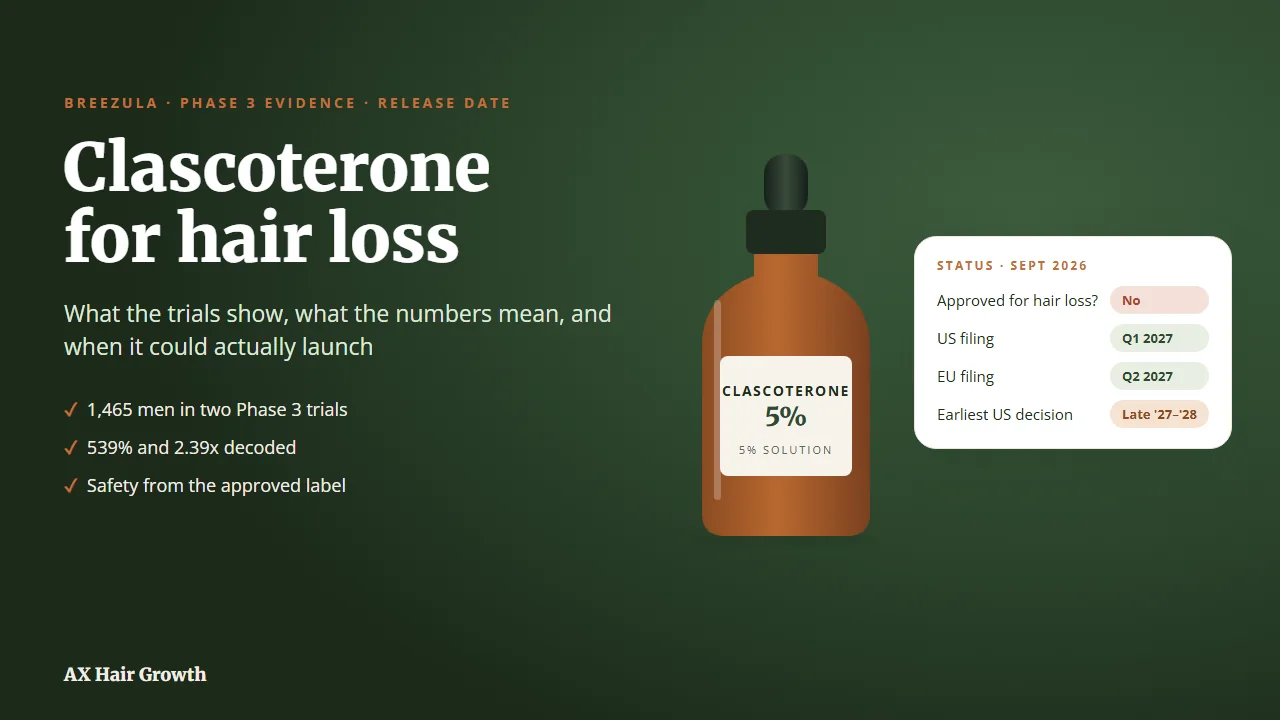

The headlines say “539% more hair”. The trial data says something narrower and still interesting. This guide covers what the numbers measure, what the safety data does and doesn’t show, and the review-clock math behind a realistic launch date. If you’re weighing your options today, our guide to hair loss solutions that actually work covers the approved treatments.
| Question | Status (September 25, 2026) |
|---|---|
| Approved for hair loss? | No, not in any country |
| Approved for acne? | Yes, as Winlevi 1% cream (US 2020, UK and EU 2025) |
| Next milestone | US filing, planned for Q1 2027 |
| Realistic decision | US: late 2027 to early 2028. EU: 2028 |
What is clascoterone?
Clascoterone (cortexolone 17α-propionate, code name CB-03-01) is a topical androgen receptor inhibitor. Italy’s Cassiopea developed it, and Cosmo Pharmaceuticals has owned Cassiopea since December 2021. It’s already sold as Winlevi 1% cream for acne. Breezula is the planned name for the 5% solution for hair loss.
Same molecule, two products. The acne cream is approved and on pharmacy shelves. Clascoterone 5% solution, the stronger liquid version tested on the scalp, is still investigational:
| Winlevi | Breezula (planned name) | |
|---|---|---|
| Strength and form | 1% cream | 5% solution |
| Use | Acne | Male pattern hair loss |
| Status | Approved: US (August 2020), UK (February 2025), EU (October 2025) | Investigational; US filing planned Q1 2027 |
| Tested in | Men and women aged 12 and over | Men aged 18 and over only |
How does clascoterone work on hair follicles?
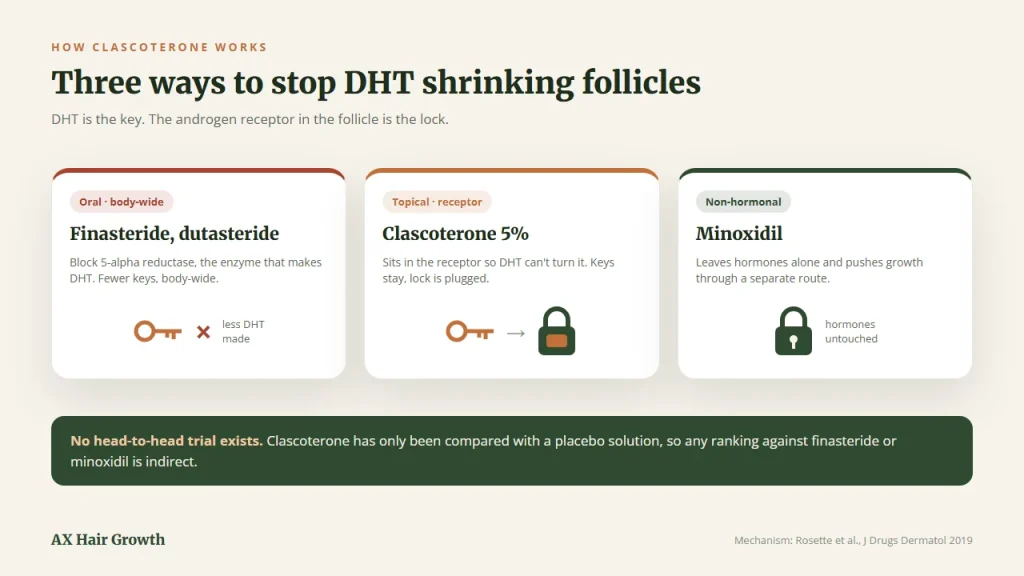
Clascoterone is a topical androgen receptor inhibitor: instead of lowering DHT, it blocks the receptor that DHT binds to in the hair follicle. The established hormonal drugs, finasteride and dutasteride, work on the supply of DHT. Clascoterone works on the lock.
Think of DHT as a key and the androgen receptor in the follicle’s dermal papilla cells as the lock. When the key turns, genes switch on that gradually shrink the follicle in men who are genetically prone to it. That’s androgenetic alopecia, or male pattern baldness.
- Finasteride and dutasteride block 5-alpha reductase, the enzyme that makes DHT. That means fewer keys, throughout the body.
- Minoxidil leaves hormones alone and pushes growth through a separate, non-hormonal route.
- Clascoterone plugs the lock, so the DHT already there can’t act on the follicle.
The lab evidence comes from Cassiopea’s own scientists. In a 2019 study of human scalp dermal papilla cells, clascoterone blocked androgen-driven gene activity about as well as finasteride. It also beat the prostate-cancer drug enzalutamide at stopping DHT-triggered release of the inflammatory signal IL-6.
Clascoterone breaks down in skin and blood into cortexolone, which is thought to be its main breakdown product. That’s why it’s pitched as “local only”. But minimal systemic exposure is not zero. With the acne cream, blood levels of cortexolone sit near the lower limit that labs can measure. With the hair loss solution, a 2021 heart-safety study by the developer found “a measurable systemic concentration and accumulation” of the drug. That study used a supratherapeutic 7.5% dose, but the difference in formulation is the point.
Does clascoterone work for hair loss? The Phase 3 evidence
Yes, in the only trials run so far. In SCALP 1 and SCALP 2, clascoterone 5% grew more hair than a matching placebo solution after 6 months, and men who kept using it kept gaining through month 12. How much more hair, in absolute numbers, hasn’t been published yet.
| Trial fact | SCALP 1 and SCALP 2 |
|---|---|
| Size | 1,465 men: SCALP 1 (NCT05910450, 703 men) and SCALP 2 (NCT05914805, 762 men), at 51 sites in the US and Europe |
| Who | Men 18 or older (no upper age limit) with Norwood IIIv to V loss. Men who had used finasteride or dutasteride in the past 6 months, or minoxidil in the past 12 weeks, were excluded. |
| Regimen used | About 1.5 mL of 5% solution by dropper to the crown and temples, twice daily |
| Design | Part 1: 6 months, double-blind, 2 men on clascoterone for every 1 on placebo. Part 2: responders re-randomized 2:1 to continue or switch to placebo for 6 more months, single-blind. |
| Primary endpoints | Change in target area hair count (TAHC, non-vellus hairs) at month 6, plus men’s own rating of their hair coverage |
| 6-month result | TAHC relative improvement vs placebo: 539% in one trial, 168% in the other. The patient rating was significant in one trial and pooled, a positive trend in the other. |
| 12-month result | Men who continued had 2.39x the TAHC improvement of men switched to placebo, and rated treatment satisfaction 24.5% higher |
| Safety | Adverse events similar to placebo, per the sponsor |
What do 539% and 2.39x actually mean?
Both are ratios, not hair counts. Cosmo described the 539% result as “5.39x”, meaning the clascoterone group’s average gain was 5.39 times the placebo group’s. A ratio like that can hide a small or a large absolute effect, depending on how much hair the placebo group gained.
A hypothetical example. These numbers are illustrations, not trial data. If the placebo group gained 2 hairs per cm², a 5.39x result means the clascoterone group gained about 10.8, a real difference of about 8.8 hairs per cm². If the placebo group gained 0.5 hairs per cm², the same 5.39x means a gain of about 2.7, a difference of 2.2. The ratio is identical, but the effect you’d see in the mirror is four times smaller. The gap between the two trials, 539% and 168%, may partly reflect different placebo responses. Cosmo hasn’t published the numbers that would settle it.
The 2.39x figure measures something narrower still. At month 6, only “responders” moved into the 12-month extension. The trial registry shows responders were chosen by the men’s own questionnaire answers, not by hair count. They were then split again: two in three kept using clascoterone, and one in three switched to placebo. So 2.39x compares men who kept using the drug with men who stopped, among men who already felt it was working. It doesn’t compare clascoterone with baseline or with men never treated. It does show one useful thing: when men stopped, their gains faded, so this is a keep-using-it treatment, like every other hair loss drug.
Relative-to-absolute calculator
Hypothetical. Enter an assumed placebo gain and a relative result to see the absolute difference. Cosmo hasn’t published the real placebo numbers.
What’s still missing from the data?
- Absolute hair counts for each group, at baseline, month 6 and month 12.
- Hair thickness and darkness. The trials photographed both, but Cosmo hasn’t reported them.
- Results beyond 12 months.
- Any data in women. Both trials enrolled men only.
- A head-to-head trial against finasteride.
- The peer-reviewed paper. Cosmo says publications will follow.
Clascoterone side effects and safety
Clascoterone side effects in the hair loss trials were similar to placebo, according to the sponsor, but the full safety data isn’t public yet. The best independent numbers come from the approved acne cream. Its label documents skin irritation, a reversible hormonal effect in a minority of heavy users, and small potassium shifts.
| What the hair loss trials report (sponsor, 2025–2026) | What the Winlevi 1% label documents (FDA) |
|---|---|
| Adverse events similar to placebo through 12 months, mostly unrelated to the drug | Local redness (12.2% vs 15.4% on placebo cream), scaling or dryness (10.5% vs 10.4%) and itching (7.7% vs 8.2%) |
| “No significant systemic hormonal side effects observed” | HPA-axis suppression at day 14 of maximal use in 1 of 20 adults (5%) and 2 of 22 adolescents (9%). All recovered within 4 weeks of stopping. |
| Tolerability “comparable to vehicle” | Potassium rose above normal in 5% of treated subjects vs 4% on placebo |
| Full tables not yet published | Large areas, long-term use and covering the skin raise absorption |
HPA-axis suppression means the brain–adrenal system that makes cortisol is temporarily dialed down. A 2026 analysis of US adverse-event reports for the acne cream also flagged HPA-axis suppression, skin stretch marks and abnormal hair growth as rare signals. That doesn’t prove the drug caused them, but they are the areas to watch.
Does clascoterone cause sexual side effects? The sponsor reports none. Because clascoterone doesn’t lower body-wide DHT the way finasteride does, fewer sexual side effects would be expected. But the solution does reach the blood in measurable amounts, and the full independent data is still pending. The honest answer is “none reported so far”.
Is clascoterone a steroid?
Clascoterone is a steroid in structure but not a corticosteroid in action. It’s an ester of cortexolone (11-deoxycortisol), a precursor the body uses to make cortisol, and it shares the four-ring backbone of DHT. It’s classified as an androgen receptor inhibitor. That steroid background is why regulators check the HPA axis. Pages that say it “is not a steroid” are wrong on chemistry. Pages that call it “a steroid cream” are wrong on how it works.
Is it the same as cortisone or clobetasol for hair loss?
No. Cortisone creams and clobetasol propionate are corticosteroids. They calm inflammation, and dermatologists use clobetasol for alopecia areata, the patchy autoimmune form of hair loss. They don’t block androgens and aren’t treatments for male pattern baldness. Clascoterone targets the androgen receptor and doesn’t act as an anti-inflammatory steroid.
Clascoterone vs finasteride, minoxidil and other options
Clascoterone and pyrilutamide are the only options here that block DHT’s receptor on the scalp itself, and clascoterone is the one heading for US and EU filings. Finasteride and dutasteride lower DHT throughout the body, and minoxidil works without touching hormones. No trial has compared clascoterone head to head with finasteride, so every comparison below is indirect.
| Option | Mechanism | Route | Systemic exposure | Evidence | Approval status |
|---|---|---|---|---|---|
| Clascoterone 5% | Blocks the androgen receptor | Topical solution | Designed to act locally; measurable blood levels in a Phase 1 study | 2 Phase 3 trials, 1,465 men; not yet peer-reviewed | Not approved; US filing Q1 2027 |
| Oral finasteride | Blocks 5-alpha reductase type 2, lowers DHT | Pill | Yes, lowers DHT body-wide | Decades of trials | Approved in the US and EU |
| Topical finasteride | Same enzyme, applied to the scalp | Spray | Much lower than oral | Phase 3 trial (2022) | Approved in some EU countries; not FDA-approved |
| Dutasteride | Blocks both 5-alpha reductase types | Pill | Yes, stronger DHT drop | Randomized trials; long-term Korean data | Approved for hair loss in South Korea and Japan; off-label in the US and EU |
| Topical minoxidil | Non-hormonal growth stimulant | Foam or solution | Low | Strong, long-standing | Approved, over the counter |
| Oral minoxidil (low dose) | Non-hormonal growth stimulant | Pill | Yes, it’s a blood-pressure drug | Growing; 2026 expert consensus | Off-label for hair loss |
| Pyrilutamide (KX-826) | Blocks the androgen receptor | Topical tincture | Designed to act locally | China Phase 3 met primary endpoint (March 2026) | Not approved; filing planned in China |
Can you combine clascoterone with minoxidil or finasteride?
The mechanisms are different, so a combination makes sense on paper. But the SCALP trials excluded men using minoxidil or 5-alpha reductase inhibitors, so no data exists on using them together. If clascoterone is approved, that’s a decision to make with a dermatologist, based on your loss pattern and history.
When will clascoterone (Breezula) be available?
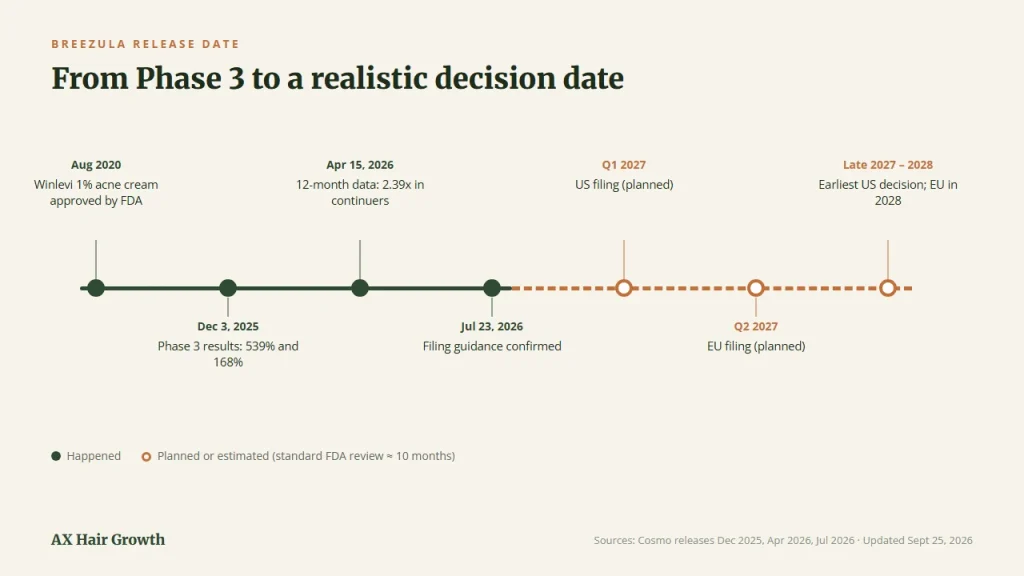
The earliest realistic US decision on clascoterone is late 2027 to early 2028, and Europe is likely 2028. Cosmo plans to file with the FDA in Q1 2027 and in Europe in Q2 2027. Add the standard review clocks and you reach those dates, assuming no delays. Any page promising a 2027 launch is ahead of the company’s own guidance.
| Date | Milestone | Status |
|---|---|---|
| December 3, 2025 | Phase 3 topline results (6 months) | Done |
| April 15, 2026 | 12-month Phase 3 data | Done |
| July 23, 2026 | Filing guidance: US Q1 2027, Europe Q2 2027 | Done |
| Q1 2027 | US submission to the FDA | Planned |
| Q2 2027 | European submission | Planned |
| About 10 months after US filing | FDA decision under a standard review | Estimate: late 2027 to early 2028 |
| 12 months or more after EU filing | EMA opinion, then European Commission decision | Estimate: 2028 |
- US: A standard FDA review of an application like this one runs about 10 months from submission. Clascoterone is already approved as Winlevi, so this is a new product rather than a new molecule. Cosmo hasn’t said it will seek priority review. Launch also depends on a commercial partner, and none has been announced.
- EU, including Sweden: Winlevi went through the EMA’s centralized procedure, which covers every EU country, Sweden included, in one approval. If Breezula takes the same route, the EMA’s evaluation usually takes a year or more. The Commission decision follows the scientific opinion; for Winlevi that took 53 days (August 25 to October 17, 2025).
- UK: No separate filing date has been announced. Winlevi reached the UK through the MHRA in February 2025, eight months before the EU. We’ll add the UK date when Cosmo or a partner confirms one.
How much will clascoterone cost?
There is no official price. Expect a prescription-only product, likely paid for out of pocket. As a rough proxy only, GoodRx listed an average US retail price of about $755 for a 60 g tube of Winlevi acne cream in September 2026. The hair loss solution is a different product, and it will be used on a larger area, so treat that figure as a floor for expectations rather than a forecast.
Tracking the filing date? Bookmark this page. We update it within 48 hours of every Cosmo release and log each change in the update log below.
Can you use Winlevi for hair loss on your scalp in the meantime?
Winlevi has never been tested for hair loss, and it isn’t a shortcut to Breezula. It’s a fifth of the strength (1% vs 5%) and a cream rather than a solution, which is hard to spread through hair onto scalp skin. It’s approved only for acne; in the EU, teenagers may use it only on the face.
The label also warns that large treated areas, prolonged use and covering the skin increase absorption. Daily, open-ended scalp treatment ticks all three boxes, and that’s exactly where the HPA-axis findings came from. A Canadian case series of 10 acne patients noted benefits for other concerns, including pattern hair loss, but that’s anecdote, not evidence. If you’re tempted, talk to a dermatologist rather than experimenting.
Is “research” or compounded clascoterone safe to buy?
There’s no way to know, and that’s the risk. “Research” CB-03-01 sold online has no regulatory oversight, so its purity, strength and solvent are unverified. Compounded versions aren’t reviewed by the FDA for safety, effectiveness or quality. With clascoterone, strength matters: HPA-axis effects rise with exposure, and an over-strength or poorly made product raises exactly the risk the label warns about. We don’t link to or name sellers.
Who is clascoterone likely to suit, and who should look elsewhere?
Clascoterone was tested in men with moderate pattern hair loss, so that’s who the evidence covers. If you’re unsure of your stage, our guide to hair loss grades and Norwood stages explains the scale.
- Likely candidates: men with mild to moderate male pattern hair loss (the trials used Norwood IIIv to V), and men who avoid or stopped finasteride because of side effects or worries about them.
- Poor fit: shedding that isn’t androgenetic, such as telogen effluvium, alopecia areata or scarring alopecia (all excluded from the trials), and advanced baldness beyond Norwood V, where follicles may be gone.
- Women: no Phase 3 data yet. The SCALP trials enrolled only men. The acne cream is approved for women, but its label reports birth defects in animal studies, so pregnancy is a real concern for any future use.
Don’t put your hairline on hold for 18 months or more. Pattern hair loss keeps progressing, and the approved options work best on hair you still have. Start an evidence-based plan with a dermatologist now, and add clascoterone later if it’s approved and suits you. Our round-up of the best hair growth solutions for men is a good place to start.
Clascoterone for hair loss: FAQ
Is clascoterone FDA-approved for hair loss?
No. Clascoterone is FDA-approved only for acne, as Winlevi 1% cream (2020). The 5% solution for hair loss finished Phase 3 in 2026, and Cosmo plans to file with the FDA in Q1 2027. A standard review of about 10 months puts the earliest US decision in late 2027 to early 2028.
Can women use clascoterone for hair loss?
There’s no evidence yet. Both Phase 3 hair loss trials enrolled only men. The acne cream is approved for women, but its label reports birth defects in animal studies, which matters for women who could become pregnant. Women with thinning hair should see a dermatologist about approved options such as minoxidil.
Does clascoterone cause sexual side effects?
None have been reported. Cosmo says adverse events matched placebo through 12 months, with no significant hormonal side effects. Clascoterone doesn’t lower body-wide DHT the way finasteride does. But the solution does reach the blood in measurable amounts, and the full data hasn’t been published for independent review.
Will clascoterone regrow a bald crown?
Probably not on a fully bald crown. The trials enrolled men with moderate loss (Norwood IIIv to V) and treated the crown and temples, where follicles were thinning but still present. No data exists for advanced baldness. Like other hair loss drugs, it’s best at protecting and thickening hair you still have.
How long does clascoterone take to work?
Expect months, not weeks. The trials measured hair counts at 3, 6 and 12 months, and Cosmo reports that treated men kept gaining hair from month 3 through month 12. The main result was judged at 6 months. Men who stopped at month 6 lost part of their gains, so it needs continued use.
Sources and update log
Update log
- September 25, 2026: Page published. Checked against Cosmo’s July 23, 2026 filing guidance and both ClinicalTrials.gov records.
We update this page within 48 hours of each Cosmo release on clascoterone.
- Cosmo Pharmaceuticals. Cosmo announces breakthrough Phase III topline results from Scalp 1 and Scalp 2 for clascoterone 5% solution in male hair loss. December 3, 2025. newsfilecorp.com
- Cosmo Pharmaceuticals. Phase III 12-month data for clascoterone 5% topical solution confirm positive safety for chronic use and continued hair growth. April 15, 2026. newsfilecorp.com
- Cosmo Pharmaceuticals. Cosmo reports double-digit recurring revenue growth in H1 2026, advances clascoterone 5% topical solution toward regulatory submission. July 23, 2026. newsfilecorp.com
- ClinicalTrials.gov. SCALP1, NCT05910450 (703 men) and SCALP2, NCT05914805 (762 men). Accessed September 25, 2026. NCT05910450 · NCT05914805
- US FDA. WINLEVI (clascoterone) cream 1% prescribing information, revised January 2025. DailyMed
- European Medicines Agency. Winlevi EPAR: CHMP opinion August 25, 2025; marketing authorisation October 17, 2025. ema.europa.eu
- Cosmo Pharmaceuticals and Glenmark. UK MHRA approval of Winlevi, February 10, 2025. Announcement
- Rosette C, Rosette N, Mazzetti A, Moro L, Gerloni M. Cortexolone 17α-propionate (clascoterone) is an androgen receptor antagonist in dermal papilla cells in vitro. J Drugs Dermatol. 2019;18(2):197-201. PMID 30811143
- Täubel J, Mazzetti A, Ferber G, et al. A phase 1 study to investigate the effects of cortexolone 17α-propionate, also known as clascoterone, on the QT interval. Clin Pharmacol Drug Dev. 2021;10(6):572-581. doi:10.1002/cpdd.935
- Kircik LH. Androgens and acne: perspectives on clascoterone, the first topical androgen receptor antagonist. Expert Opin Pharmacother. 2021;22(13):1801-1806. doi:10.1080/14656566.2021.1918100
- Dhillon S. Clascoterone: first approval. Drugs. 2020;80(16):1745-1750. doi:10.1007/s40265-020-01417-6
- Tao L, et al. Adverse events associated with clascoterone: a real-world pharmacovigilance study of the FAERS database. Ther Innov Regul Sci. 2026;60(4):1112-1123. doi:10.1007/s43441-026-00968-2
- Tay E, Loo WJ. Real-world experience of clascoterone cream 1% in acne management: case series and Canadian experience. Clin Cosmet Investig Dermatol. 2025;18:161-167. doi:10.2147/CCID.S498879
- Piraccini BM, et al. Efficacy and safety of topical finasteride spray solution for male androgenetic alopecia: a phase III, randomized, controlled clinical trial. J Eur Acad Dermatol Venereol. 2022. doi:10.1111/jdv.17738
- Gupta AK, Talukder M, Williams G, et al. Low-dose oral minoxidil and topical minoxidil: consensus recommendations for managing male and female pattern hair loss. Expert Opin Pharmacother. 2026;27(3):253-261. doi:10.1080/14656566.2026.2642216
- Kearney CA, et al. Androgenetic alopecia in women: a narrative review. Am J Clin Dermatol. 2026;27(2):363-389. doi:10.1007/s40257-026-01009-2
- PMDA (Japan). Report on the deliberation results: dutasteride for male androgenetic alopecia, September 4, 2015. pmda.go.jp; and long-term dutasteride data in Korean men, PMID 38321615
- BioWorld. Kintor’s KX-826 meets phase III endpoints in alopecia. March 19, 2026. bioworld.com
- Saged NM, Obaid ZM, Fouda I. Topical metformin compared with clobetasol propionate for alopecia areata. Dermatol Pract Concept. 2026;16(1). doi:10.5826/dpc.1601a5941
- Cosmo Pharmaceuticals and Cassiopea. Settlement of public exchange offer for all publicly held shares in Cassiopea. December 17, 2021. cosmopharma.com
- GoodRx. Winlevi prices, checked September 2026. goodrx.com