

Hair loss grade classification is a standardized system that assigns measurable stages to hair thinning and balding patterns, giving clinicians and patients a shared language for diagnosis and treatment planning. The two most recognized systems are the Norwood Scale for men and the Ludwig Scale for women. Knowing your grade tells you where you stand on the hair loss severity spectrum and which treatments are realistically on the table. Androgenetic alopecia affects approximately 50% of men by age 50, making accurate classification more than an academic exercise. It is the first concrete step toward doing something about it.
What is hair loss grade classification and why does it matter?
Hair loss grade classification is the practice of using validated scales to categorize the pattern and severity of hair loss. Without a grading system, two clinicians examining the same patient might describe the condition completely differently. With one, they can communicate precisely, track progression over time, and match the patient to evidence-based treatments.
The grading system also sets realistic expectations. A person at Norwood Stage 2 has very different surgical candidacy than someone at Stage 6. A woman at Ludwig Grade I responds differently to topical minoxidil than one at Grade III. Classification is the foundation every treatment decision is built on.
Classification scales help communicate hair loss severity but do not identify underlying causes on their own. That distinction matters. A scale tells you how much hair is gone. It does not tell you why. That answer requires a clinical evaluation.
How does the norwood scale classify male pattern hair loss?
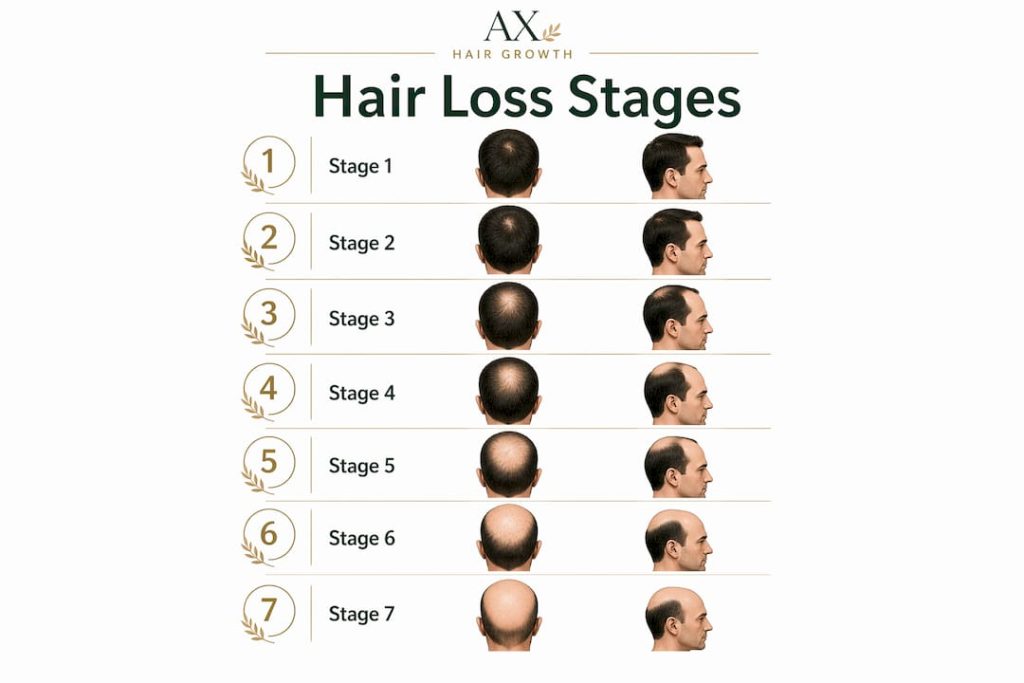
The Norwood Scale, formally called the Hamilton-Norwood Scale, is the primary hair loss grading system for men. It organizes male pattern baldness into 7 primary stages, from a full head of hair at Stage 1 to a narrow horseshoe band of hair at the sides and back at Stage 7.

Norwood stages at a glance
| Stage | Description | Clinical Significance |
|---|---|---|
| 1 | No visible hair loss | Baseline; no treatment needed |
| 2 | Slight recession at temples | Early androgenetic alopecia |
| 3 | Deep temporal recessions | First clinically significant loss |
| 3 Vertex | Thinning begins at crown | Dual-zone loss pattern |
| 4 | Significant crown and temple loss | Moderate baldness |
| 5 | Thin bridge between zones | Advanced progression |
| 6 | Bridge disappears | Severe baldness |
| 7 | Only side and back fringe remains | Most advanced stage |
Approximately 42% of men aged 18–49 experience moderate to extensive hair loss at Stage 3 or higher. Stage 3 is the threshold where hair loss becomes clinically significant, marked by deep recessions at the temples that are visible without close inspection.
The scale also includes Type A variants, which affect a distinct pattern of hair loss. Instead of the classic crown thinning seen in standard stages, Type A variants affect roughly 20% of men and show uniform frontal recession moving backward across the scalp without a separate crown bald spot. This distinction changes both the visual presentation and the surgical approach.
Pro Tip: If your hairline is receding straight back without a separate bald spot forming at the crown, you may have a Type A variant. Standard Norwood stage photos often do not show this pattern, which is why many men misidentify their own stage.
How does the ludwig scale classify female pattern hair loss?
The Ludwig Scale is the standard hair loss grading scale for women with androgenetic alopecia. It focuses on the crown region and organizes hair loss into 3 grades based on crown thinning and density reduction.
- Grade I: Mild thinning along the part line. The scalp becomes slightly more visible, but overall density looks near normal to most observers.
- Grade II: Noticeable widening of the part and visible scalp across the crown. Hair volume decreases significantly.
- Grade III: Advanced denudation of the crown. The scalp is clearly visible across a wide area, though the frontal hairline is typically preserved.
Female pattern hair loss differs from male pattern in one key way. Women rarely lose their frontal hairline. The thinning spreads outward from the crown, which is why the Ludwig Scale centers on that zone. However, this focus is also the scale’s biggest limitation.
Women may experience frontal hairline recession that the Ludwig Scale does not capture at all. A woman with significant frontal thinning could receive a Grade I classification and still have a presentation that requires more aggressive treatment. That gap is why a dermatologist’s full scalp exam matters beyond any self-assessment tool.
Pro Tip: Photograph your part line under bright, direct light every three months. The widening of the part is often the first measurable sign of Grade I progression, and photos make the change undeniable when you might otherwise dismiss it.
What are the different types of hair loss beyond pattern baldness?
The Norwood and Ludwig scales apply specifically to androgenetic alopecia. They do not cover every type of hair loss, and misapplying the Norwood Scale to alopecia areata or scarring alopecia can lead to misdiagnosis and the wrong treatment path.
Hair loss is broadly classified as scarring or non-scarring, and that distinction changes everything about prognosis and treatment.
- Androgenetic alopecia (non-scarring): The most common type, classified by Norwood or Ludwig. Follicles miniaturize but remain alive, so regrowth is possible with treatment.
- Alopecia areata (non-scarring): An autoimmune condition causing patchy loss. Follicles are intact but suppressed. The Norwood Scale does not apply. Diagnosis relies on pattern recognition and biopsy.
- Telogen effluvium (non-scarring): Diffuse shedding triggered by stress, illness, or hormonal shifts. Hair loss is temporary in most cases. No standard grading scale exists; severity is measured by shed rate and duration.
- Traction alopecia (non-scarring initially, scarring if chronic): Caused by repeated tension on hair follicles from tight hairstyles. Early stages are reversible. Chronic cases cause permanent follicle damage.
- Scarring alopecias (e.g., lichen planopilaris, frontal fibrosing alopecia): Scarring alopecias cause permanent follicle damage and require completely different evaluation frameworks. Regrowth is not possible in affected areas. Treatment focuses on halting progression, not reversing loss.
Recognizing the difference between scarring and non-scarring alopecia is the most clinically important classification decision a dermatologist makes. Getting it wrong delays effective treatment and can allow permanent damage to progress unchecked.
How is hair loss classification used for treatment planning?
Hair loss severity levels directly determine which treatments are appropriate and which are not. Classification is not just a label. It is a clinical decision-making tool.
| Norwood/Ludwig Stage | Common Treatment Options | Expected Outcome |
|---|---|---|
| Norwood 1–2 / Ludwig Grade I | Minoxidil, finasteride, bhringraj oil, amalaki powder | Maintenance and mild regrowth |
| Norwood 3–4 / Ludwig Grade II | PRP therapy, low-level laser therapy, medications | Slowing progression, some regrowth |
| Norwood 5–6 / Ludwig Grade III | Hair transplant evaluation, combination therapy | Restoration in transplanted zones |
| Norwood 7 | Limited transplant candidacy, scalp micropigmentation | Cosmetic improvement only |
Surgical planning depends heavily on the hair loss grading system. Norwood and Ludwig scales assess the donor zone and the extent of balding to determine whether a patient has enough healthy follicles at the back and sides to cover the bald area. A Stage 7 patient with a thin donor zone may not have enough hair for a full transplant, regardless of how much they want one.
For non-surgical options, classification guides dosing and product selection. Axhairgrowth highlights treatments like bhringraj oil and amalaki powder, both of which have clinical support for use in early to moderate stages where follicles are still active. These are most effective at Norwood Stages 1–3 or Ludwig Grades I–II, when the follicle is miniaturized but not gone.
Professional consultation is critical before acting on any self-assessment. Classification scales are tools to facilitate diagnosis, not replace it. Nutritional deficiencies, thyroid dysfunction, and hormonal imbalances can all cause or worsen hair loss without changing your Norwood or Ludwig grade.
Key takeaways
Hair loss grade classification is the foundation of every effective treatment decision, from topical remedies to surgical planning.
| Point | Details |
| Two primary scales exist | The Norwood Scale classifies male pattern loss in 7 stages; the Ludwig Scale classifies female pattern loss in 3 grades. |
| Stage determines treatment fit | Early stages respond to medications and natural remedies; advanced stages may require surgical evaluation. |
| Scales have real limits | Neither Norwood nor Ludwig applies to scarring alopecia, alopecia areata, or telogen effluvium. |
| Scarring vs. non-scarring matters most | Scarring alopecia causes permanent follicle damage; non-scarring types preserve regrowth potential. |
| Professional evaluation is non-negotiable | Classification scales identify severity but cannot reveal root causes like hormonal or nutritional factors. |
Why classification scales are misunderstood more than they should be
I have seen a lot of people walk into a conversation about hair loss armed with a Norwood stage they looked up online and a treatment plan they built around it. The problem is that the scale gave them a number, not a diagnosis.
The Norwood Scale was designed as a communication tool between clinicians. When patients use it for self-diagnosis, they often miss the nuances that change everything. Type A variants get misclassified. Women with frontal recession get told they are Grade I when their actual presentation is more complex. And people with alopecia areata try to map patchy loss onto a scale that was never built for it.
What I find most overlooked is the follicle status question. Two people at Norwood Stage 4 can have completely different prognoses depending on whether their remaining follicles are miniaturized or dormant. A scale cannot tell you that. A trichoscopy or scalp biopsy can.
The other thing worth saying plainly: classification is not a ceiling. A Stage 3 does not mean you are headed to Stage 7. Progression varies enormously based on genetics, age of onset, and how early treatment begins. Use your grade as a starting point, not a verdict.
— Adrian
Find the right solution for your hair loss stage
Understanding your hair loss stage is only useful if it leads somewhere. Axhairgrowth builds its content and product recommendations around exactly this idea: your grade shapes your options.
Whether you are at an early stage looking to maintain density or further along and exploring what is still possible, Axhairgrowth provides stage-specific guidance backed by clinical research. The site covers evidence-based options including bhringraj oil and amalaki powder, both shown to support follicle health in non-scarring alopecia. Visit Axhairgrowth to explore hair growth tips matched to your specific stage and hair loss type.
FAQ
What is hair loss grade classification?
Hair loss grade classification is a standardized system that assigns measurable stages to hair thinning and balding patterns. The most widely used systems are the Norwood Scale for men and the Ludwig Scale for women.
What are the norwood scale stages?
The Norwood Scale has 7 primary stages, from no visible hair loss at Stage 1 to a narrow fringe at the sides and back at Stage 7. Type A variants, affecting roughly 20% of men, show a different pattern of uniform frontal recession.
How do hair loss severity levels affect treatment options?
Early stages (Norwood 1–3, Ludwig Grade I) respond well to medications, natural remedies, and PRP therapy. Advanced stages may require hair transplant evaluation, and Stage 7 patients often have limited surgical candidacy due to donor zone constraints.
Can women use the norwood scale to classify their hair loss?
No. The Norwood Scale is designed for male androgenetic alopecia. Women should use the Ludwig Scale, though it has limits since it does not account for frontal hairline recession that some women experience.
Do hair loss classification scales identify the cause of hair loss?
Classification scales measure severity and pattern but do not reveal root causes. Hormonal imbalances, nutritional deficiencies, and autoimmune conditions require clinical evaluation beyond what any grading scale provides.