

Boil rosemary for 30 minutes and you’ll destroy compounds that handles hair growth.
Most recipes online are wrong. Your water turns dark, smells potent, yet it does almost nothing because heat kills the compounds before they can reach your scalp.
This guide is for those who want to make the best rosemary water for hair growth. The ratio, timing, fresh vs dried, and why adding clove can further enhance this hair elixir.
What Is Rosemary Water (And Why Does It Actually Work)?
Before we make recipes, let’s talk science for a minute because understanding why it works will help you make better decisions on how to prepare rosemary water for hair growth.
Rosemary has several compounds that your hair loves:
- Rosmarinic acid — A water-soluble antioxidant that can reduce scalp inflammation and promote healthy follicles. That’s the primary ingredient you’re extracting when you make rosemary water.
- Carnosic acid — The ingredient that does the heavy-lifting for your hair growth. It inhibits DHT (the hormone responsible for pattern hair loss) and enhances scalp blood flow. Here’s the catch: carnosic acid is not water-soluble, and it needs oil or alcohol to extract fully.
- Caffeic acid and other polyphenols — Antioxidants that protect your hair follicles from oxidative stress and extend the growth phase of your hair.
What this means practically: Rosemary water and rosemary oil have different mechanisms of action. Rosemary water is lighter, non-greasy, and extracts the water-soluble ingredients. If you want the full spectrum of benefits, use both. Water daily and oil weekly will give you complementary effects.
Researchers compared rosemary oil to 2% minoxidil in 100 patients with androgenetic alopecia. After six months, both groups got equivalent hair count increases, but the rosemary party experienced significantly less itching on the scalp. That’s great evidence for a kitchen-made remedy for hair.
How to Make Rosemary Water for Hair Growth: Boiling & The Complete Timing Guide
This is the question everyone asks, and for good reasons because most recipes get it wrong.
The short answer: Simmer (no aggressive boiling) for 15-20 minutes for standard potency.
The longer answer: It depends on what you’re planning to use it for.
| Strength | Simmer Time | Steep After | Best For |
| Mild | 5-10 minutes | 15-30 minutes | Daily use, sensitive scalps, fine hair |
| Standard | 15-20 minutes | 30-60 minutes | Most users, weekly treatments |
| Strong | 20-30 minutes | 1-2 hours | Intensive treatment, thick/coarse hair |
Why Overboiling Destroys Your Rosemary Water

Here’s what nobody tells you: aggressive boiling for 30+ minutes degrades the volatile oils that give rosemary its hair-growth potential. The aromatic flavors you smell? Yeah, they’re leaving with the steam.
The fix is simple:
- Bring water to a rolling boil
- Add rosemary and immediately reduce to a gentle simmer
- Cover the pot to trap the volatile compounds
- Simmer for your desired time (check the table above)
- Remove from heat and let it steep until it’s completely cool
That last step matters. The steeping time extracts even more compounds while also preventing you from burning yourself or damaging your spray bottle with hot liquid.
Rosemary Water Ratios: Fresh vs. Dried Conversion Chart
One of the biggest confusions is how much rosemary to use, especially when recipes won’t tell you fresh or dried.
Fresh Rosemary Ratios
| Strength | Fresh Rosemary | Water |
| Light | 2-3 sprigs (4″ each) | 3 cups |
| Standard | 5 sprigs (6″ each) | 2 cups |
| Strong | 8-10 sprigs | 2 cups |
Dried Rosemary Ratios
| Strength | Dried Rosemary | Water |
| Light | 1 teaspoon | 1 cup |
| Standard | 2 tablespoons | 1 liter (4 cups) |
| Strong | ¼ cup | 1 liter |
The Conversion Rule
2-3 fresh rosemary sprigs ≈ 2 teaspoons dried rosemary
Another interesting finding from the research is that dried rosemary actually offers you higher polyphenol content in water extractions than fresh rosemary. The drying process concentrates these beneficial substances.
If you think dried is “inferior”, it’s not. It’s equally effective, but more consistent, and you can store it for months.
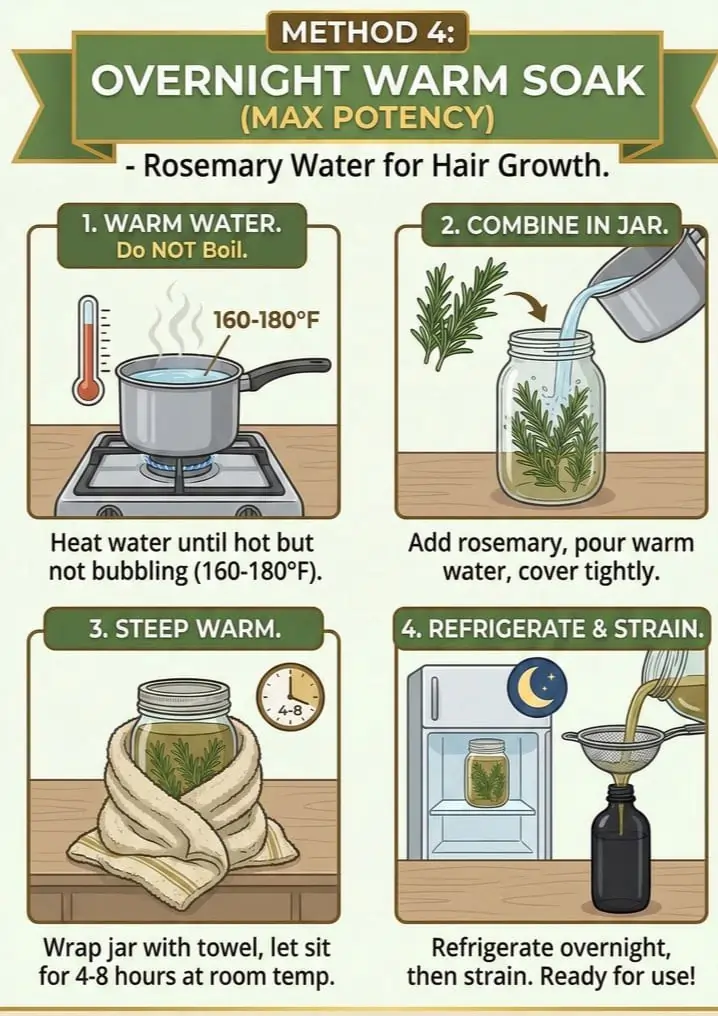
4 Methods to Make Rosemary Water for Hair Growth (Step-by-Step)
Different extraction methods provide different compound profiles. Here’s how each one works, so you can choose based on your time preference and what your hair needs.
01. The Classic Simmer
The standard industry method. Effective when done properly.
What you’ll need:
- 2-3 cups distilled/filtered water
- 5 fresh rosemary sprigs (or 2 tbsp dried)
- Saucepan with lid & Fine strainer
Instructions:
- Bring water to a rolling boil.
- Add rosemary; reduce to low simmer.
- Cover and simmer for 15-20 mins.
- Cool completely (1-4 hrs) with lid on.
- Strain and refrigerate immediately.
02. Hot Infusion
Gentler extraction to preserve delicate aromatic oils.
Instructions:
- Bring water to a full boil then remove from heat.
- Add rosemary to hot (not boiling) water.
- Cover tightly immediately.
- Steep for 2-4 hours (overnight is ideal).
- Strain and refrigerate.
How to Make Rosemary Water Spray vs. Hair Rinse
Same rosemary water, but different applications. Here’s when to use each.
💧 Rosemary Water Spray
Best for daily maintenance and direct scalp stimulation.
How to use:
- Transfer to a fine-mist spray bottle.
- Part hair into sections to expose the scalp.
- Spray directly along each part line.
- Massage gently with fingertips for 2 minutes.
- Leave in until your next wash.
🚿 Rosemary Hair Rinse
Best for wash days and full-length hair health.
How to use:
- Shampoo and condition as normal.
- Prepare 2-3 cups of room-temp rosemary water.
- Lean back and slowly pour over the scalp.
- Massage into the scalp for 2 minutes.
- Rinse with cool water or leave in completely.
Should You Rinse It Out or Leave It In?
Both works. Leaving it in means longer contact time with your scalp. Rinsing out can prevent any potential dryness on your hair length. Rosemary can be slightly drying for some.
My recommendation: Leave it in, but put it only on your scalp and not your hair length. If needed, use a regular leave-in conditioner on your ends.
How to Make Rosemary and Clove Water for Hair Growth
This combination has gone viral, and I’m surprised it took so long.
Clove has about 70% eugenol, a substance that enhances blood circulation for hair follicles and has also antimicrobial properties. Mixing provides a synergistic growth-bosting formula.
The Recipe
Ingredients:
- 5 fresh rosemary sprigs OR 2 tablespoons dried rosemary
- 5-7 whole cloves (not ground)
- 2 cups filtered water
Instructions:
- Bring water to a boil
- Add rosemary and cloves
- Reduce to simmer, cover, and cook for 15 minutes
- Remove from heat and steep until completely cool (1-2 hours)
- Strain into spray bottle
- Refrigerate
Important note: Both rosemary and cloves are strong herbs. If you have a sensitive scalp, start with a few cloves (3-4) and increase gradually. Some people experience tingling, but that’s normal. Burning or persistent irritation isn’t.
Other Effective Additions
| Addition | How to Add | Benefits |
| Rice water | Mix 50/50 with rosemary water after straining | Adds amino acids, strengthens hair shaft |
| Green tea | Add 1 tea bag during steeping | Extra antioxidants, follicle stimulation |
| Peppermint | Add 3-5 fresh leaves OR 3 drops essential oil | Cooling sensation, additional circulation boost |
| Apple cider vinegar | Add 1 tbsp per cup after cooling | Clarifying, extends shelf life, pH balance |
Caution with combinations: More is not better. Start with rosemary alone, check with your scalp if it tolerates it, then add one ingredient at a time.
Should you use rice oil for hair or oil if you want hair growth? Focus on making your own water rinse, instead.
How to Make Rosemary Water for Hair Without Boiling
You can ditch the stove. Here are two methods:
Essential Oil Method
Ingredients:
- 2 cups distilled water
- 8-10 drops rosemary essential oil
- Small spray bottle
Instructions:
- Add water to spray bottle
- Add rosemary essential oil drops
- Shake vigorously before each use because oil and water don’t mix
Pros: Instant, no prep time, more concentrated
Cons: Essential oils are different from whole-herb extracts, and you must have quality oil. Can also irritate sensitive scalps
How Often to Use Rosemary Water for Hair Growth
Depends on your hair type and how your scalp responds.
General Guidelines
| Hair Type | Frequency | Notes |
| Fine/Thin | 2-3x weekly | Can weigh down hair if used daily |
| Normal | 3-5x weekly | Sweet spot for most people |
| Thick/Coarse | Daily | Can handle more frequent application |
| Oily scalp | 2-3x weekly | Rosemary helps regulate sebum |
| Dry scalp | Daily | Add aloe vera for extra hydration |
| Curly/Coily (3C-4C) | Daily on scalp | Focus on scalp, not hair lengths |
Signs You’re Using It Too Often
- Scalp feels dry or tight
- Hair feels straw-like
- Increased flaking
- Scalp irritation or redness
If you notice any of these, calm down on the frequency and consider diluting your rosemary water 50/50 with plain water.
How Long to Keep Rosemary Water in Hair
Short answer: You can leave it in until your next wash. There’s no need to rinse it off.
Detailed breakdown:
- Minimum effective time: 10-15 minutes (for rinse-out method)
- Optimal: 30+ minutes to overnight
- Maximum: Until your next shampoo (typically 2-3 days)
The active substances absorb into your scalp over time. Longer contact means more absorption. Can cause dryness for some hair types if leaving water on hair lengths (not scalp) for longer.
Best practice: Apply to your scalp and leave in. Use a leave-in conditioner on your ends separately.
Storage, Shelf Life, and Signs Your Rosemary Water Has Gone Bad
Homemade rosemary water contains no preservatives. This means bacteria can grow. Here’s how to maximize the freshness:
Shelf Life by Storage Method
| Storage | Duration |
| Room temperature | 24-48 hours MAX (not recommended) |
| Refrigerated | 1-2 weeks |
| Refrigerated with distilled water | Up to 3 weeks |
| Frozen (ice cube trays) | Up to 3 months |
Best Containers
- Dark glass spray bottles — Protects from light degradation
- Mason jars with tight lids — Great for larger batches
- BPA-free plastic spray bottles — Acceptable, but glass is better
Signs It’s Gone Bad (Discard Immediately)
- Sour, “off,” or rotten smell
- Cloudy appearance (beyond its normal slight tint)
- Visible mold or floating particles
- Slimy texture
- Color changed to murky brown
Pro tip: Label every container with the date you made it. When in doubt, make a fresh batch. Takes only 20 minutes and is better than a scalp infection.
Common Mistakes That Ruin Your Rosemary Water
After checking in on forums, Reddit threads, and TikTok comments, these are the mistakes I see constantly:
Preparation Mistakes
- Aggressive boiling for 30+ minutes — Destroys volatile compounds. Gentle simmer, 15-20 minutes max.
- Not covering the pot — It lets the beneficial aromatics escape with steam. Always cover.
- Using tap water — Chlorine and minerals reduce shelf life and can affect the extraction. Use filtered or distilled water.
- Wrong ratios — Too weak = no benefit. Too strong = scalp irritation. Follow the charts above.
- Skipping the cool-down — Hot rosemary water will damage your spray bottle and can irritate your scalp.
Storage Mistakes
- Leaving at room temperature — Bacteria multiply fast. Refrigerate within 2 hours of creation.
- Unclean containers — Wash and dry your spray bottle before each new batch.
- Making month-long supplies — It will spoil before you finish. Make enough that will cover 1-2 weeks’ use.
Application Mistakes
- Rinsing out immediately — Give it time to absorb. At least 10-15 minutes.
- Applying to oiled hair — Oil creates a barrier. Apply to a clean scalp.
- Spraying only on hair lengths — Benefits come from scalp interaction. Part your hair, spray the roots.
- Expecting overnight results — Real results take 3-6 months. If you quit after a few weeks, you’ll never see the true potential.
- Skipping the patch test — Spray a small amount behind your ear, wait 24 hours. This is better than discovering an allergy on your scalp.
Hidden Gem Tips Most Articles Miss: Make the Best Rosemary Water at Home
These techniques I found from deep research, and not the surface-level advice you’ll find elsewhere.
1. The Cold Pre-Soak Method
Soaking rosemary in cold water for 4 hours before heat doubles the initial phenolic concentration.
How to do it:
- Place rosemary in cold water, refrigerate for 4 hours
- Transfer to saucepan and proceed with your normal heating method
- The result is noticeably darker and more potent
2. Warm Your Scalp First
Your scalp temperature affects how well compounds penetrate. Before applying rosemary water:
- Do 1-2 minutes of scalp massage to increase blood flow
- Or apply a warm (not hot) damp towel to your head for 2 minutes
This can significantly increase absorption of the beneficial compounds in this plant.
3. The “Dirty Hair” Myth Debunked
You may have heard that rosemary water works better on unwashed hair. The opposite is true. Clean scalp = better absorption. Product buildup and sebum will create a barrier. Apply rosemary water to freshly washed (and dried) hair for optimal penetration. Use a scalp brush as well.
What Results to Actually Expect (Realistic Timeline)
Let’s be frank. You’ll not grow three inches of hair in a month. Simply because this is not how hair works.
Here’s what the research and real user experiences suggest:
Week 1-4: Foundation Phase
- Scalp may feel cleaner, less itchy
- Some users notice early “baby hairs” (small, fine new growth)
- Hair might feel slightly different in texture
- Don’t expect visible length changes in this time frame
Month 1-3: Early Signs
- Reduced shedding (fewer hairs in brush/shower drain)
- Improved hair texture and shine
- You’ll notice more baby hairs along your hairline
- Scalp feels healthier
Month 3-6: Visible Results
- This is when clinical studies show their measurable changes
- Noticeable new growth, especially at hairline and part
- Hair appears thicker/fuller
Month 6+: Maintenance
- Continued improvement
- Results plateau due to your genetic potential
Also, how long it takes for hair to grow depends on specific underlying causes.
The “Initial Shedding” Question
Some people report increased shedding in the first 2-4 weeks. This can be alarming, but it’s often a sign that your hair cycle is resetting. Old hair is making space for new hair growth. If shedding continues past 6 weeks or feels excessive, stop and consult a specialist.
Non-Responders Are Real
The honest truth: not everyone responds to rosemary. Around 30-40% see minimal results from any given hair treatment. If you’ve been consistent for 6+ months with no improvement, rosemary may not be your solution, but that doesn’t mean nothing will work for you.
Hair Type-Specific Recipes and Protocols
For Fine/Thin Hair
- Recipe: Use the mild strength ratio (less rosemary, more water)
- Frequency: 2-3 times weekly
- Application: Spray bottle only, rinses can weigh down fine hair
- Key tip: Avoid adding oils to your rosemary water because they might flatten fine strands
For Thick/Coarse Hair
- Recipe: Use the strong strength ratio
- Frequency: Daily is fine
- Application: Either spray or rinse
- Key tip: Your hair can handle more, try to combine with cloves and other additions
For Oily Scalp
- Recipe: Standard strength, add 1 tbsp apple cider vinegar per cup
- Frequency: 2-3 times weekly
- Application: Focus on scalp only, rosemary helps regulate sebum
- Key tip: Don’t add any oils to your formula
For Dry Scalp or Dandruff
- Recipe: Standard strength, add 1 tbsp aloe vera gel after straining
- Frequency: Daily use is beneficial
- Application: Leave in overnight when possible
- Key tip: Follow with a light oil on your ends (not scalp) to prevent dryness
For Natural/4C Hair
- Recipe: Standard or strong strength with cloves
- Frequency: Daily
- Application: Spray bottle, apply to your scalp before protective styles or while hair is in sections
- Key tip: Focus entirely on the scalp because your hair’s lengths need moisture, not rosemary
For Color-Treated Hair
- Recipe: Mild to standard strength (no ACV because it can strip color)
- Frequency: 2-3 times weekly
Note: Rosemary might slightly darken your light-colored hair over time. This is temporary and washes out.
Safety Considerations: Who Should Avoid Rosemary Water
Rosemary is generally safe for topical use, but there are important exceptions:
Pregnancy and Breastfeeding
Consult your doctor before using. Rosemary consists of compounds that may stimulate uterine contractions in high amounts. Topical use in moderate amounts is likely fine, medical guidance is essential.
Allergies
If you’re allergic to plants in the mint family (basil, oregano, sage, lavender), you may get a reaction from rosemary. Always patch test behind your ear 24 hours before a full application.
Medication Interactions
Rosemary may interact with:
- Blood thinners
- ACE inhibitors (blood pressure medications)
- Diuretics
- Lithium
If you take any of these, talk to your healthcare specialist first.
Sensitive Scalp Conditions
If you have an active scalp condition like psoriasis flares, open wounds, or severe dermatitis, wait until you manage these before trying rosemary water.
The Bottom Line
Making rosemary water for hair growth isn’t complicated once you understand the principles:
- Simmer gently (15-20 minutes), don’t boil aggressively
- Cover your pot to trap volatile compounds
- Use proper ratios—fresh or dried both work
- Store in the fridge and use within 2 weeks
- Apply to clean scalp, leave in, be consistent
- Give it 3-6 months before judging your results
The evidence supporting rosemary for hair growth is great. Clinical studies and traditional use for centuries can’t be wrong. Plus, the countless real-world success stories. It’s also cheap, simple, and free from the side effects that come with pharmaceutical options.
Some people use onion juice mixed with rosemary water aswell for hair growth. But that’s not a nice smell. Instead, try adding hibiscus flowers for hair growth.
Or if you need a more agressive way, try peptides for hair growth.
Will it work for you? There’s only one way to find out. Grab some rosemary, fresh from the garden, dried from your spice rack, or a bunch from the grocery store, and make your first batch today.
If you want more hair tips to boost your hair growth further, try scalp massages before applying rosemary water.
Your hair will thank you in six months.
How long does rosemary water last?
Homemade rosemary water lasts 1-2 weeks refrigerated in a clean, airtight container. Using distilled water can extend this to 3 weeks. For longer storage, freeze in ice cube trays (up to 3 months) and thaw as needed.
Can I use rosemary water every day?
Yes, for most hair types. Daily use is fine for dry, normal, thick, or coarse hair. If you have fine hair or an oily scalp, 2-3 times weekly is sufficient. Reduce frequency if you notice any scalp dryness or irritation.
How do I make rosemary water with dried rosemary?
Use 2 tablespoons dried rosemary per liter of water for standard strength. Bring water to a boil, add dried rosemary, reduce to simmer for 15-20 minutes covered. Let cool completely before straining. Dried rosemary is equally effective—research suggests it may even produce higher polyphenol content than fresh.
What’s the difference between rosemary water and rosemary oil?
Rosemary water extracts water-soluble compounds (rosmarinic acid, polyphenols). Rosemary oil extracts fat-soluble compounds (carnosic acid—the primary DHT blocker). They work through different mechanisms. Using both provides complementary benefits.
How long should I boil rosemary for hair?
Don’t boil—simmer. Bring water to a boil, add rosemary, then reduce to a gentle simmer for 15-20 minutes. Aggressive boiling destroys volatile compounds. Always cover the pot to trap beneficial aromatics.
Can rosemary water darken my hair?
Rosemary may subtly darken blonde or light-colored hair with prolonged, repeated use. The effect is temporary and washes out over time. If this concerns you, use the mild strength formula less frequently.
When will I see results from rosemary water?
Most users notice improved scalp feel and reduced shedding within 4-8 weeks. Visible new hair growth typically appears at 3-6 months with consistent use. The clinical study showing equivalence to minoxidil measured results at 6 months.
Is rosemary water safe during pregnancy?
Consult your doctor. Rosemary contains compounds that may stimulate uterine contractions. While topical use in moderate amounts is generally considered low-risk, medical guidance is essential during pregnancy.
Can I add essential oils to my rosemary water?
Yes, but do so after the rosemary water has cooled completely. Add 5-8 drops of rosemary essential oil, peppermint oil, or tea tree oil per cup of rosemary water. Shake before each use since oil and water separate.
What does it mean if my rosemary water smells bad?
It’s spoiled. Discard immediately and make a fresh batch. Spoiled rosemary water can harbor bacteria that may cause scalp infections. Signs of spoilage include sour smell, cloudiness, visible mold, or slimy texture.
Should I rinse rosemary water out or leave it in?
You can do either. Leaving it in provides longer contact time with your scalp and is generally recommended. If you rinse, leave it on for at least 10-30 minutes first. Apply to scalp only—leaving it on hair lengths may cause dryness.
How do I make rosemary water without boiling?
Two options: (1) Cold infusion — Bruise rosemary leaves, add to cold water, refrigerate overnight, strain. (2) Essential oil method — Add 8-10 drops rosemary essential oil to distilled water, shake before use.